

Time to Get Tactical-Scheduling Your Writing for Success
Organize yourself so you don't fall into the pit of procrastination


This is a part of an ongoing series on how to write a Sourcebook in 12 weeks. Catch up with the series here.
Get Yourself Organized
By now, you should have your category and your outline. If you don’t, the next steps will be hard. You’re going to take that beautiful outline and plan out how to make it a reality. I get it, sometime you like to read the book before you do the steps. That’s fine, but make sure you actually get to writing your book. Nothings worse than preventable regret.
Planning your 12 weeks
12 weeks is the perfect amount of time to write a book. It gives you enough slack to be human, but not so much that you feel comfortable goofing off. Your outline where you’ll start for scheduling your 12 weeks.
I’m going to give you two options for your writing plan. One that’s for my type A folks, who like everything scheduled out, and one for my type B people who want a little more wiggle room. Again, it’s not important which one you pick. What’s important is that you pick and get to work!
Calendaring
If you get comfort in knowing when you’re going to be doing what most hours of the day, this is the method for you. Spend an afternoon thinking about when you’re going to write what. You don’t have to write linearly.
You really don’t! It’s a trap a lot of intermediate writer’s get caught in. Start with page one and write the whole thing until it’s done. Sounds good, isn’t good.
Here are some questions to help you decide what to write…
What ideas are you most excited about? Start with those.
Which ideas do you need to write about first, so you have greater clarity?
Do you need to research more? Allow time for that.
Is there an interview you’re going to conduct? Make sure that’s on the calendar.
Anything else that’s gnawing at your subconscious? Pay attention to those voices.
After you’ve done your thinking about what to write when, you’re free to toss it in a calendar. It’ll look something like this…
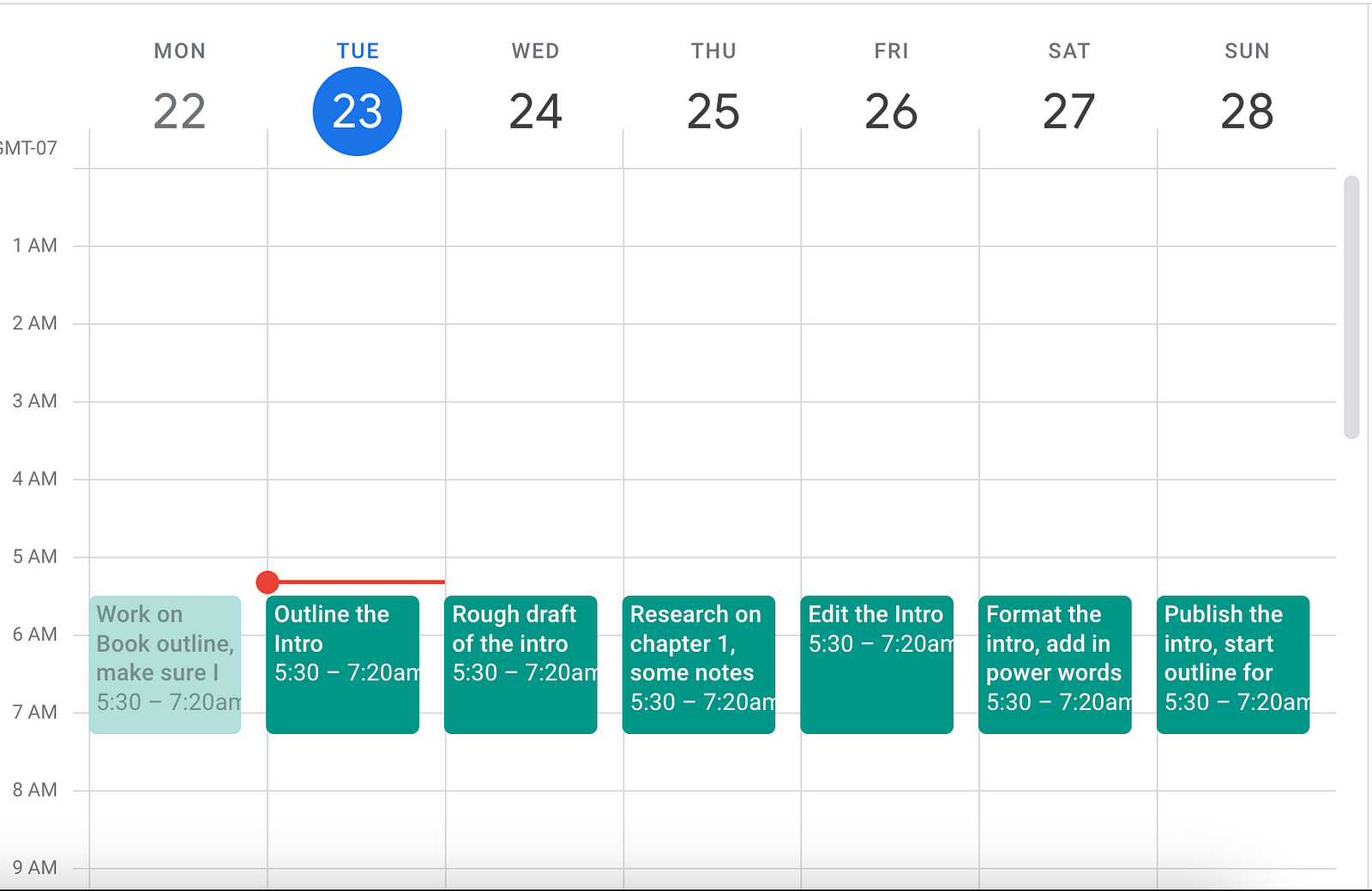
Or, with my added chaos, like this…
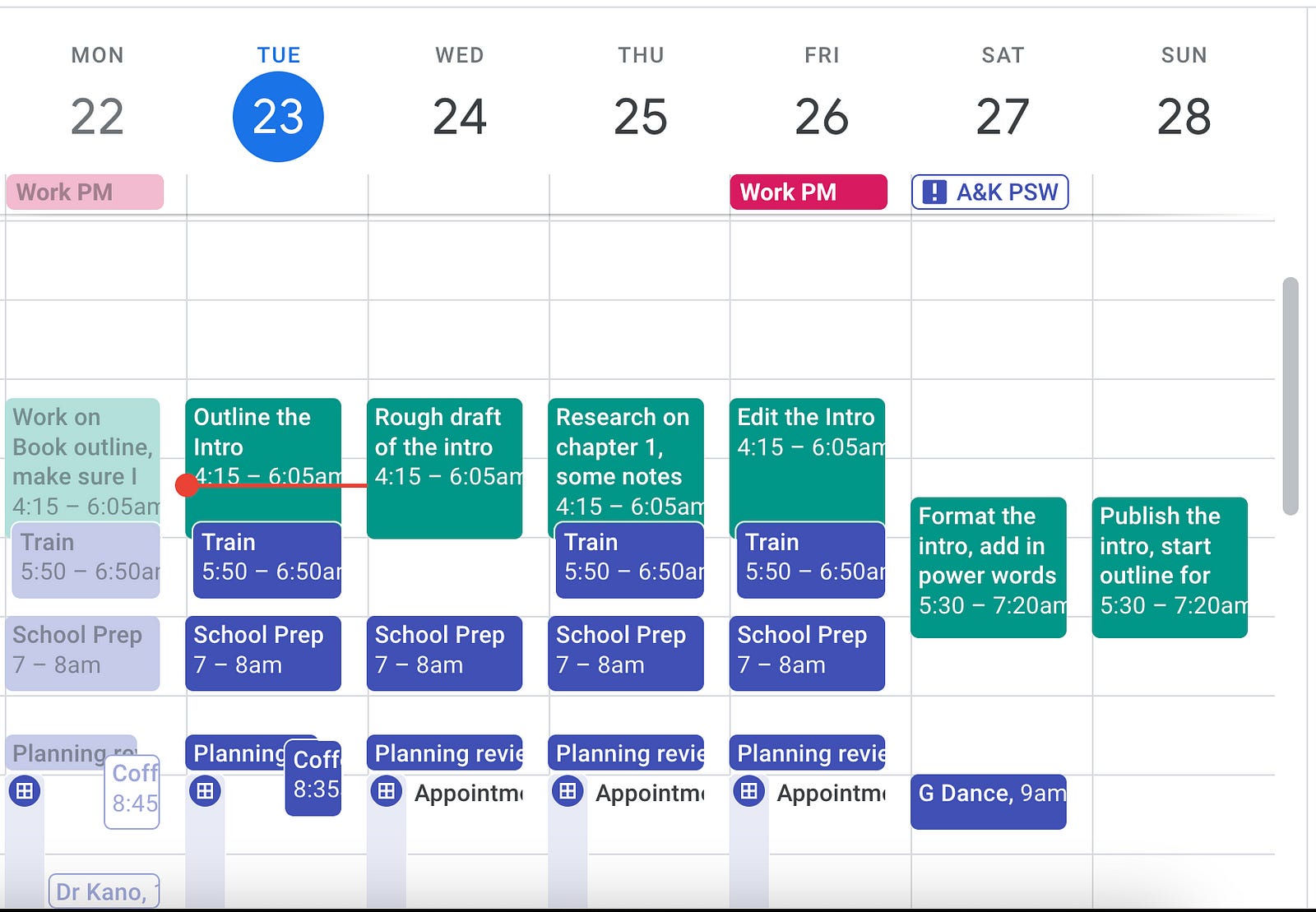
I always write at the same time every morning. 4:30am, M-F, and 5am S-Su. You don’t have to write early in the morning, but I recommend having a consistent writing slot in your calendar. Even if you don’t know what you’re going to write, have an event that says “Write.” It’s an appointment and you can’t break it.
Documenting
I call this method Documenting. Instead of putting your writing on a calendar, like above, you create a document for each section/chapter you’re going to write. Then you have a “to-do” folder, and a “done” folder. Like this:
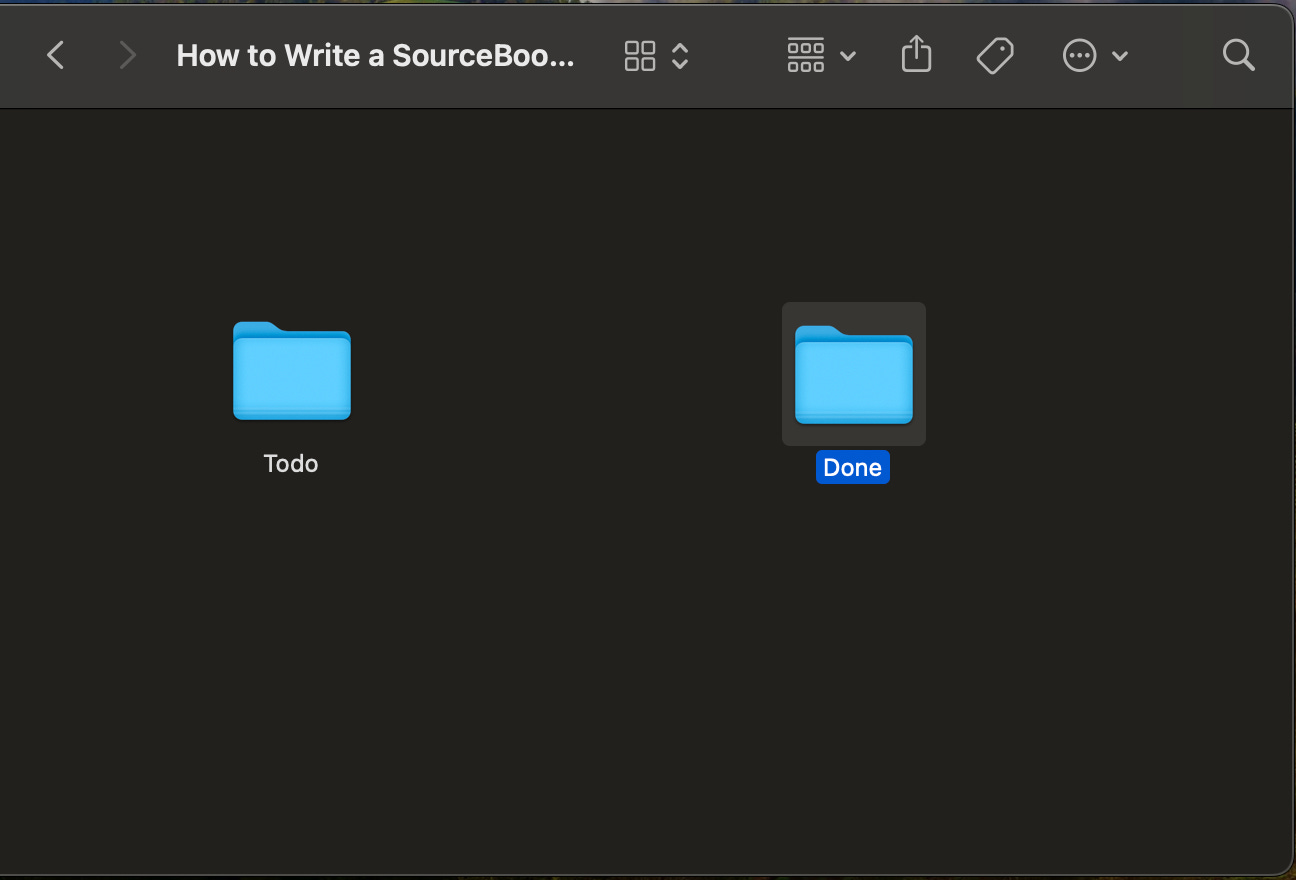
Then, when it comes time to write, you open up one of the documents in your “to-do” folder and get to work. When you’re done with it you move it from to-do to done. It gives you a visual representation of how much work you’ve accomplished and how much is left to do. (You can combine this with your calendar system for extra motivation).
Using a service like Google Drive, Microsoft 365, or even Notion is a great way to manage your documents as well. Just make sure you have redundant back ups. There’s nothing worse than losing all your work because of a network error…
The downside of this method is since you don’t have a hard calendar driving you to write, you could fall behind. You know how it goes, you start with vivre and vinegar and then around week four your attention wanes… At the end of this chapter I’ll give you my Foolproof Motivational Notecard System for Guaranteed Success.
If you like the idea of a calendar to keep you on track, but don’t like the rigidity of having to write what your past self told you to write, you can always quarantine off an hour or two a day. Call it “Writing Time” and then you know when you’re supposed to write. For me it’s 4:30 on weekdays and 5:00 on weekends.
Scrivener
I use a variation of the Documentation strategy. There’s a program called Scrivener, which allows me to create folders, sub folders, documents, and write all in one place. I create one document for each new project, and then I have everything I need in front of me. It looks like this:
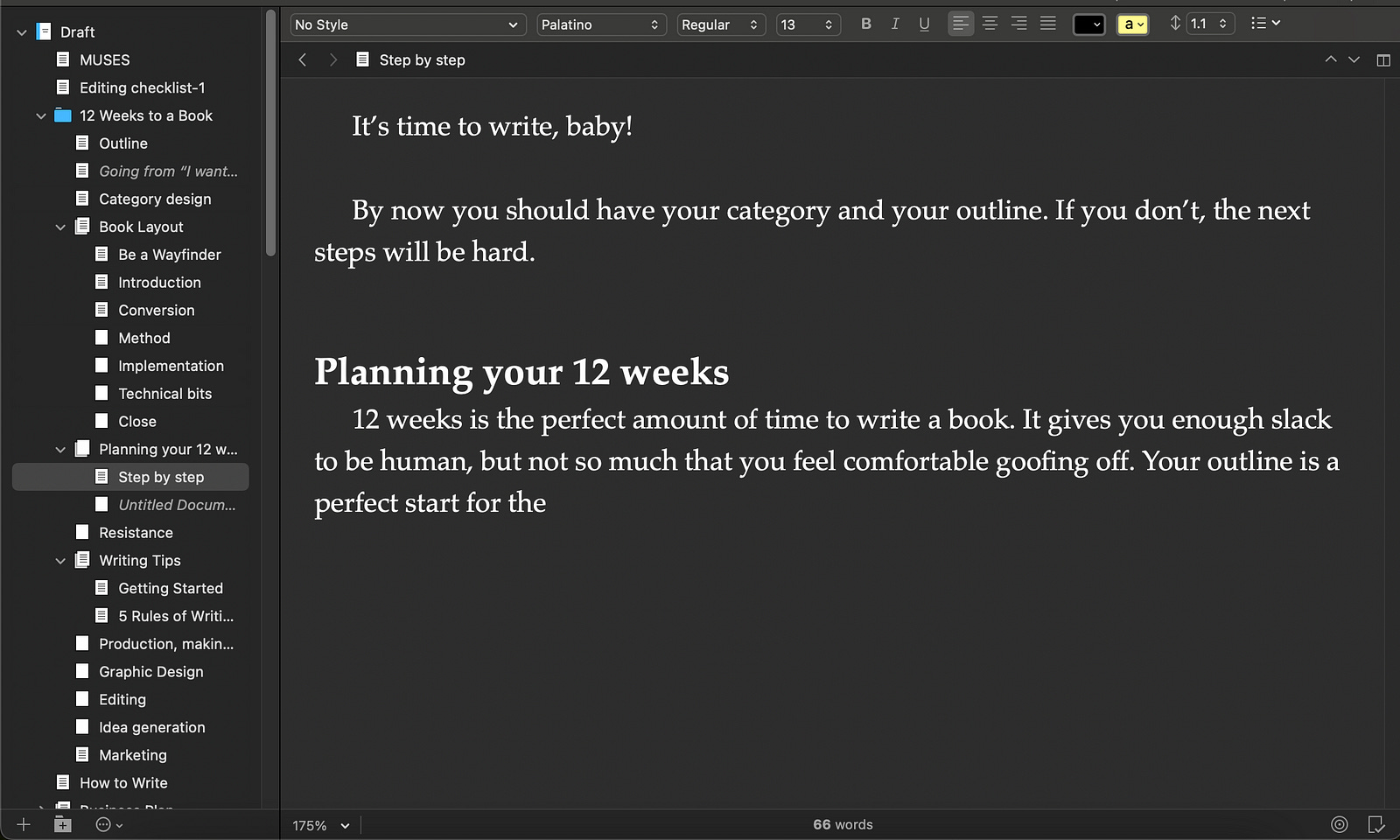
It’s a lot easier to manage than a large Word or Google Doc. I’ve been using Scrivener for over a decade and I still love it. You can outline, write, edit, and compile an entire book in the software. Without nerding out too much, the software also allows you to drag and drop your chapters, so you can move your ideas around. It’s my favorite and it’s pretty cheap.
Here’s my affiliate link if you want to get a free trial: Scrivener
I don’t care which method you choose. All I care about is that you choose one and use one. The best is probably a combination of the two. You know you best. Don’t complicate this and enter productive procrastination.
There’s a guy who wants to accomplish great things, so he spends weeks planning. But just before he goes to launch, he notices his website isn’t exactly perfect. You fix that. Then the house isn’t clean. And your desk? It’s a mess. Honestly, you also need an entirely new set of dishes… Pretty soon ten years have gone by and there’s still nothing on the board.
Don’t be that guy.
The Foolproof Motivational Notecard System for Guaranteed Success Longevity and Happiness
I suck at productivity systems. And it’s not for a lack of trying. I’ve read all the books, taken the courses, used my mentor’s systems, but I still couldn’t get anything done. Then I tested all the software, still nothing.
So I stripped things down. The question was: “What’s the smallest thing I could do to be productive?” Google Calendar, too complicated. The Tasks app? Nope — anything on the computer or phone puts me in a place where I can get distracted. Written calendars got lost and unused.
“What’s smaller than a calendar?” I thought…
Notecards. 3x5 cards, to be exact.
The system is Kian proof. I sit down in the morning, take out three 3x5 cards, and write one task per card.
That’s it.
The cards live in my pocket, next to my phone. When I complete a task I pull out the card and rip it up. If I have a card left in my pocket at the end of the day I’ll try to get it done. And if I can’t, I leave it next to my pile of 3x5’s for the next day.
Write what you plan to write that day, and you’ve got a foolproof “system” to making sure you get done what you intend to get done. This isn’t a writing system on it’s own, you need to Document or Calendar as the backbone. My notecards act as a physical reminder to get my act together and write.
Enough for now, go write something
-Kian
Stick around a while…